
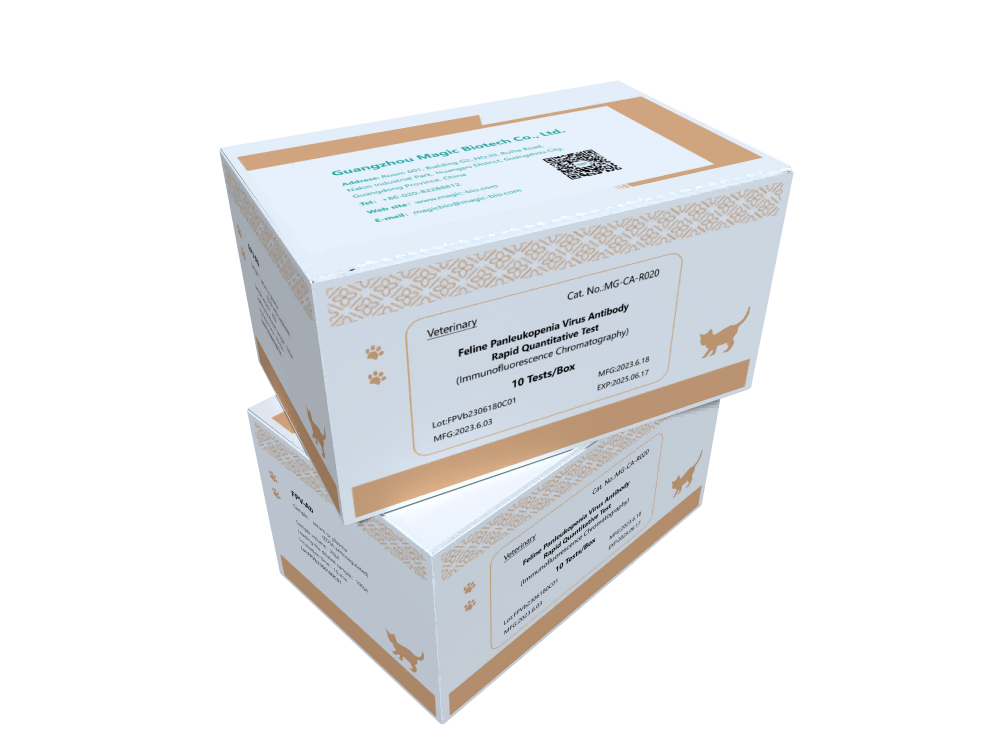
SDMA Chronic Kidney Disease Test Kit
Quantitative SDMA test for early CKD detection in dogs and cats — muscle-mass-independent, 10–20 min.
Indicative price range: US$20–80 per kit. Final pricing (specification, order quantity and OEM terms) is confirmed in the written quotation.
The Migibio SDMA Rapid Quantitative Test Kit measures symmetric dimethylarginine (SDMA) — a sensitive, muscle-mass-independent biomarker of glomerular filtration rate — for the early detection and staging of chronic kidney disease (CKD) in dogs and cats.
TL;DR — The SDMA is a quantitative fluorescence immunoassay used with a Migibio Immunofluorescence Analyzer. It ships as a 10-test/box kit, a 2-year shelf life, and a quantitative analyzer result. For clinical interpretation, see Kidney Disease Tests for Dogs and Cats: SDMA and Cystatin C.
Applications & Who It’s For
- Veterinary clinics — same-visit quantitative SDMA results for early kidney screening.
- Animal hospitals — serial monitoring of renal biomarkers in at-risk and senior patients.
- Reference labs & multi-vet hospitals — high-throughput batch testing on the analyzer.
- B2B distributors — room-temperature storage and a 2-year shelf life simplify stocking.
See also: Kidney Disease Tests for Dogs and Cats: SDMA and Cystatin C.
Product Specifications
| Attribute | Value |
|---|---|
| Tests | 10 |
| Place of Origin | China |
| Storage | Room temperature |
| Shelf life | 2 years |
Intended Use
The SDMA test is a fluorescence immunoassay designed for use with an Immunofluorescence Analyzer for the quantitative determination of symmetric dimethylarginine (SDMA) in canine or feline serum or plasma. It is intended as an aid in the early detection and staging of chronic kidney disease (CKD).
For in vitro diagnostic use only. For professional use only.
Clinical Significance
Symmetric dimethylarginine (SDMA) is a sensitive renal biomarker that increases with as little as 25–40% loss of kidney function — much earlier than creatinine. Unlike creatinine, SDMA is minimally affected by muscle mass, making it especially valuable in young, geriatric, or cachectic patients.
Quantitative SDMA measurement enables early detection of chronic kidney disease (CKD), more accurate staging, and timely initiation of renoprotective therapy in both dogs and cats.
Test Principle
The test utilizes a quantitative fluorescence immunoassay technique. Fluorescent-labelled antibodies specifically bind SDMA present in the specimen. The fluorescence signal intensity reflects the amount of SDMA captured and is converted by the analyzer into a quantitative concentration value (µg/dL).
Specimen Collection and Preparation
The test is performed using serum or plasma. Separate serum or plasma (EDTA anticoagulant recommended) from blood within 3 hours of collection. If a specimen is severely hemolyzed, obtain and test a new specimen.
Perform the test immediately after specimen collection. If testing cannot be performed within 3 hours, store the specimen at 2 ~ 8℃ for up to 72 hours. For long-term storage, keep the specimen below -20℃ and avoid repeated freezing and thawing.
Test Procedure
Refer to the Immunofluorescence Analyzer Operation Manual for detailed instructions.
- Bring all reagents and specimens to room temperature (18 ~ 28℃).
- Insert the ID Chip into the analyzer and read the standard curve.
- Pipette the prepared sample into the sample buffer and mix gently.
- Pipette the mixed sample into the sample well (S) of the Test Device.
- Run the Standard or Quick test mode on the analyzer and read the quantitative result.
Interpretation of Results
Results are reported quantitatively in µg/dL. The analyzer automatically calculates and displays the SDMA concentration. Each laboratory should establish a reference range representative of the population being evaluated. Persistently elevated SDMA values support a diagnosis of chronic kidney disease and inform IRIS staging and therapeutic decisions.
Warnings and Limitations
- This kit is for in vitro diagnostic use only.
- Do not use beyond the expiration date or if the pouch is damaged.
- Use a new pipette tip for each specimen.
- Factors such as technical error or interfering substances in the specimen may affect results.
Clinical Context
When to Test
During senior wellness screening, before nephrotoxic drugs or anaesthesia, or when chronic kidney disease is suspected in a dog or cat.
Why Test
SDMA can rise when as little as 25–40% of kidney function is lost and is largely independent of muscle mass, supporting earlier CKD detection and IRIS staging.
Interpretation
Use the kit IFU reference interval and serial measurements; persistently elevated SDMA above the reference interval supports CKD detection and IRIS staging when combined with clinical findings.
Limitations
SDMA should be interpreted with creatinine, urinalysis, clinical signs, and other diagnostics; a single value does not stage or diagnose CKD alone.
FAQ
What is the intended use of the Migibio SDMA Rapid Quantitative Test Kit?
The SDMA test is a fluorescence immunoassay used with an Immunofluorescence Analyzer for the quantitative determination of symmetric dimethylarginine (SDMA) in canine or feline serum/plasma. It is intended as an aid in the early detection and staging of chronic kidney disease (CKD). For in vitro diagnostic use only.
What detection principle does the SDMA test use?
The test uses a quantitative fluorescence immunoassay. Fluorescent-labelled antibodies bind SDMA in the specimen; the fluorescence signal intensity is measured by the analyzer and converted into an SDMA concentration value.
Why is SDMA better than creatinine for early kidney disease detection?
SDMA increases when as little as 25–40% of kidney function is lost, well before creatinine rises. It is also largely independent of muscle mass, making it more reliable in young, geriatric, or cachectic patients.
How are SDMA results interpreted?
Results are reported in µg/dL. Each laboratory should establish its own reference range. Persistently elevated SDMA values above the reference interval support a diagnosis of chronic kidney disease and guide IRIS staging and therapy decisions.
Which analyzer does this run on?
It is used with a Migibio Immunofluorescence Analyzer; follow the analyzer operation manual.
What is the shelf life and storage?
Shelf life is 2 years; storage is RT.
What sample does it use?
The test is performed using serum or plasma.