
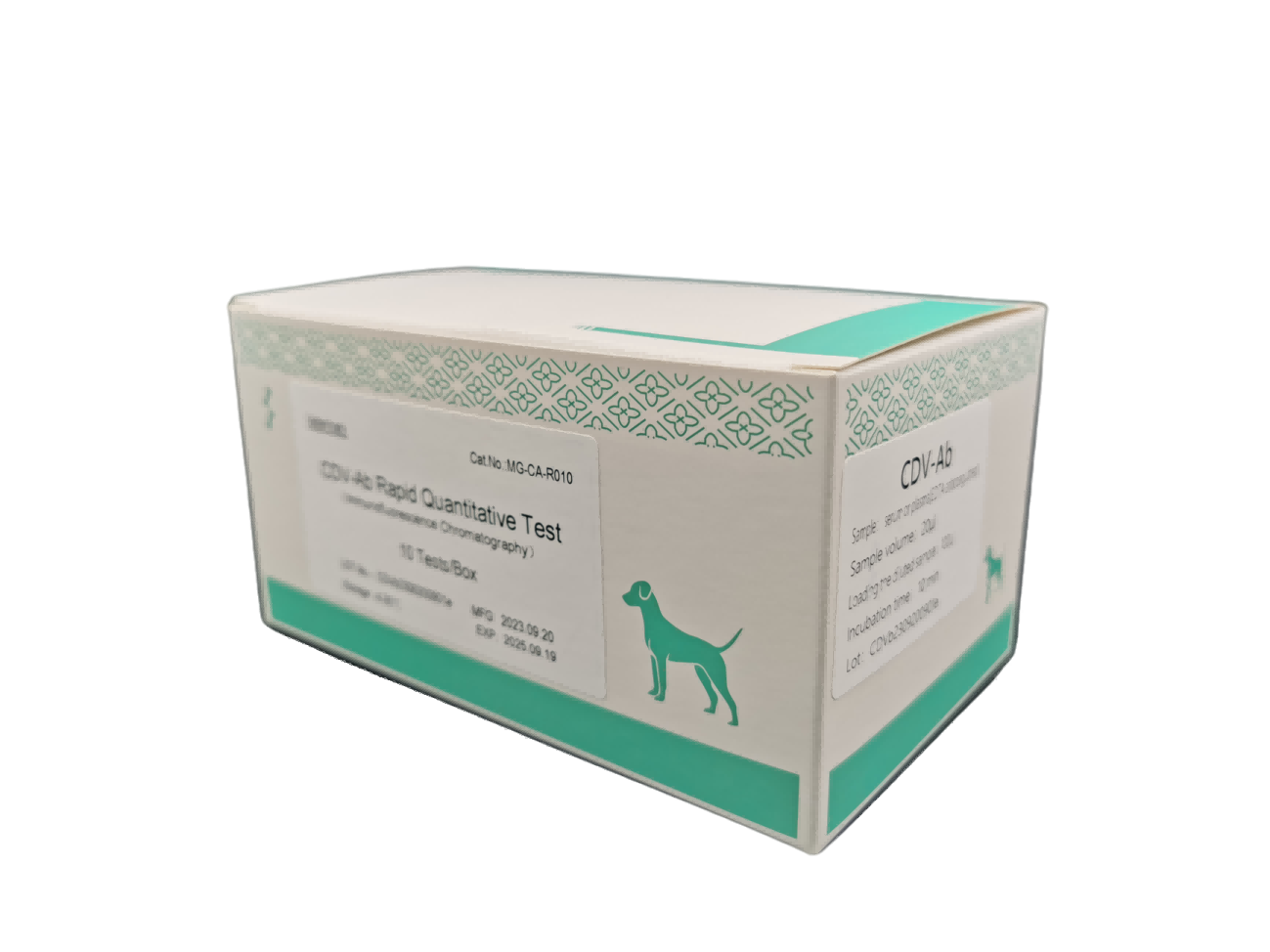
CDV-Ab Canine Distemper Virus Antibody Test Kit
Catalog No.: MG-CA-R010
Quantitative Canine Distemper Virus Antibody (CDV-Ab) fluorescence test for canine — 10–20 min results. ISO9001/GMP.
Indicative price range: US$20–80 per kit. Final pricing (specification, order quantity and OEM terms) is confirmed in the written quotation.
Catalog Number: MG-CA-R010
TL;DR — The Canine Distemper Virus Antibody (CDV-Ab) is a quantitative fluorescence immunoassay used with a Migibio Immunofluorescence Analyzer. It ships as a 10-test/box kit, a 2-year shelf life, an MOQ of 10 boxes, and a 10-minute Quick Test result. For clinical interpretation, see Distemper Tests for Dogs: Antigen vs Antibody Results.
Applications & Who It’s For
- Veterinary clinics & animal hospitals — same-visit quantitative Canine Distemper Virus Antibody (CDV-Ab) results to support diagnosis and case management.
- Shelters & catteries — intake screening and vaccination or immunity screening where Canine Distemper Virus Antibody (CDV-Ab) is part of the admission panel.
- Breeders & kennels — monitor infection or immunity status in breeding and boarding groups.
- Reference labs & multi-vet hospitals — batch multiple devices on the analyzer for high-throughput reporting.
See also: Distemper Tests for Dogs: Antigen vs Antibody Results.
Product Specifications
| Attribute | Value |
|---|---|
| Place of Origin | China |
| Classification | Specific Reagents |
| CAT No. | MG-CA-R010 |
| Package | Box |
| Appearance | Liquid |
| Specification | 10T |
| Storage | Room Temperature |
| Shelf life | 2 years |
| MOQ | 10 boxes |
| Suitable for | Veterinary |
| Grade | Reagent Grade |
Specification
Package Size : 10 Tests/Box Catalog Number : MG-CA-R010
Intended Use
The CDV-Ab test is a fluorescence immunoassay designed for use with an Immunofluorescence Analyzer. It quantitatively determines distemper virus antibody (CDV-Ab) concentration in serum or plasma. This test helps assess CDV-Ab titer levels following pet vaccinations, guiding whether re-vaccination is necessary. Additionally, it supports diagnosing and monitoring canine distemper virus infections. For in vitro diagnostic use only . Professional use only.
Clinical Significance
Canine distemper virus (CDV) is a highly contagious, often fatal morbillivirus affecting multiple body systems. Vaccination is highly protective, and antibody titres are a reliable measure of immunity.
Quantitative CDV antibody measurement supports confirmation of vaccination efficacy, identification of susceptible animals, and management of vaccination schedules in breeding kennels.
Test Principle
The test uses a quantitative double-antigen sandwich fluorescence immunoassay technique. Fluorescent signal intensity correlates with the amount of CDV-Ab captured, with results expressed in Tu/ml.
Materials Provided
Contents Quantity Individual Sealed Pouches 10
-
- Test Device Per pouch
-
- Desiccant Pouch Per pouch ID Chip 1 Instructions for Use 1 CDV-Ab Sample Buffer Tubes 10 Pipette Tips 10 Materials Required but Not Provided: Immunofluorescence Analyzer Timer Pipette Centrifuge
Storage and Stability
Store the kit at 4–30℃ up to the expiration date. Operate the test between 18–28℃ after opening the pouch. Perform the test within 30 minutes of opening the pouch.
Specimen Collection and Preparation
The test can be used with serum or plasma (EDTA anticoagulant recommended). Separate serum or plasma within 3 hours of blood collection. Avoid severely hemolyzed specimens. Test immediately after collection. If testing is delayed beyond 3 hours, store at 2–8℃ for up to 72 hours, or below -20℃ for long-term storage. Bring specimens to room temperature before testing. Avoid repeated freezing and thawing.
Test Procedure
Refer to the Immunofluorescence Analyzer Operation Manual for complete instructions. Place the Test Device on a clean, level surface. Insert the ID Chip into the analyzer and confirm the lot numbers match. Add 20 μl of sample to the CDV-Ab Sample Buffer and mix gently. Transfer 100 μl of the mixture to the sample well (S) of the test device. Select Test Mode: Standard Test : Insert the test device into the analyzer immediately, select “Serum/Plasma,” and start the test. Results will be displayed automatically. Quick Test : Let the test device sit at room temperature for 10 minutes, then insert it into the analyzer and start the test. Results will be displayed on-screen and can be printed automatically or manually.
Quality Control
Each test includes an internal control. If this control fails, the analyzer will display an error message, prompting a retest.
Result Interpretation
Detection Range : 4.5 ~ 640 Tu/ml Reference Ranges : Result (Tu/ml) Level Suggestion ≤ 10 0 No antibody protection; vaccination recommended. 10 - 20 1 Weak protection; supplementary immunization suggested. 20 - 50 2 Weak protection; immunization adjustment recommended. 50 - 100 3 Moderate protection; monitor every 6 months. 100 - 200 4 Moderate protection; monitor every 6 months.
200 5 Strong protection; test annually to ensure vaccine coverage. Note : If a pet has not been vaccinated but shows a level above 1, past infection is possible. Each laboratory should establish its own reference range based on the population being tested.
Warnings and Limitations
For in vitro diagnostic use only . Check the packaging for damage before use. Do not use damaged test devices. Do not use expired test devices. Use a new pipette tip for each sample. Potential factors such as technical errors or unknown substances in blood specimens may interfere with test accuracy.
Clinical Context
When to Test
After canine distemper vaccination or when distemper immunity and booster need are being assessed.
Why Test
Quantitative CDV antibody measurement supports assessment of vaccine-induced immunity.
Interpretation
Interpret the titre with the kit IFU, vaccination history, and exposure risk; serial testing may be more informative than a single value.
Limitations
Antibody titres do not guarantee complete protection and should be used with clinical judgement and other diagnostics.
FAQ
What is the intended use of the Migi (Dog) Canine Distemper Virus Antibody (CDV-Ab) Rapid Quantitative Test Kit?
The CDV-Ab test is a fluorescence immunoassay designed for use with an Immunofluorescence Analyzer. It quantitatively determines distemper virus antibody (CDV-Ab) concentration in serum or plasma. This test helps assess CDV-Ab titer levels following pet vaccinations, guiding whether re-vaccination is necessary. Additionally, it supports diagnosing and monitoring canine distemper virus infections. For in vitro diagnostic use only . Professional use only.
What detection principle does the Migi (Dog) Canine Distemper Virus Antibody (CDV-Ab) Rapid Quantitative Test Kit use?
The test uses a quantitative double-antigen sandwich fluorescence immunoassay technique. Fluorescent signal intensity correlates with the amount of CDV-Ab captured, with results expressed in Tu/ml.
What are the storage and stability requirements?
Store the kit at 4–30℃ up to the expiration date. Operate the test between 18–28℃ after opening the pouch. Perform the test within 30 minutes of opening the pouch.
Which analyzer does this run on?
It is used with a Migibio Immunofluorescence Analyzer; follow the analyzer operation manual.
What is the MOQ and shelf life?
The listed MOQ is 10 boxes; shelf life is 2 years.
What sample does it use?
The test can be used with serum or plasma (EDTA anticoagulant recommended).